DTF Transfers 101 introduces readers to the essentials of direct-to-film printing, offering a clear entry point for curious creators. As a beginner’s guide, it outlines the equipment you’ll need and how the process comes together, with clear examples and common pitfalls to avoid. This primer contrasts the DTF approach with other methods to help you choose the best path for your projects. Topics like color management, curing, and heat-press settings are explained with practical steps. By the end, you’ll have a solid blueprint to start printing reliably and confidently.
From a film-based ink transfer perspective, the method uses a printer to deposit pigments onto a specialty sheet before application to fabric. The role of the release layer, adhesive powder, and heat activation is described in lay terms to help beginners grasp the sequence. Compared with direct garment printing, this process offers fabric compatibility, color control, and cost efficiency for small runs. The focus shifts from technical jargon to establishing a repeatable workflow that yields consistent results across colors and garments. With this broader framing, you can plan a scalable setup rather than chasing every gadget, enabling steadier production as you learn.
DTF Transfers 101: A Beginner’s Roadmap to Direct-to-Film Printing
DTF Transfers 101 serves as a practical introduction to direct-to-film printing. This roadmap helps newcomers move from curiosity to consistent results by outlining the core concepts, material choices, and a repeatable workflow. By framing the process as a step-by-step journey, you’ll gain confidence in selecting inks, films, and powders tailored for beginners while understanding how each decision affects wash durability and color brightness.
Within this DTF printing guide for beginners, you’ll discover what sets DTF apart from other transfer methods and how to approach projects designed for beginners. Whether you’re testing a new idea or launching a small apparel line, the emphasis on a repeatable process helps you avoid common missteps associated with DTF transfers for beginners. From setup to final transfer, you’ll build a practical playbook that translates the theory you read into reliable, vibrant results.
How DTF Works: Core Principles Behind Direct-to-Film Printing
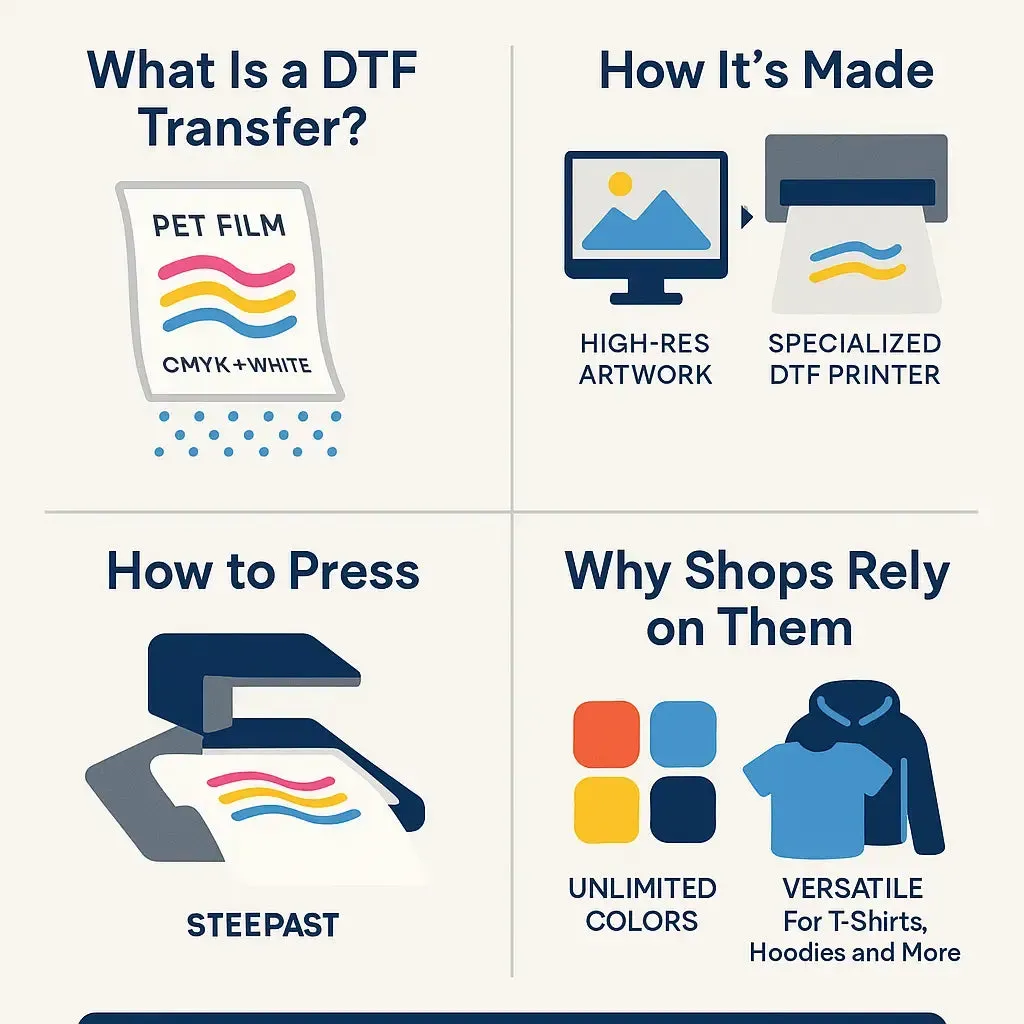
Direct-to-film printing begins with printing a substrate-friendly image onto a specialized DTF film, often using a white underbase to improve opacity on dark fabrics. The process then adds an adhesive powder, which is cured before the garment receives a heat-press transfer. Understanding this sequence helps demystify the mechanics of how DTF works and why the print can remain flexible and durable after washing.
Knowing the core mechanics also informs material choices and workflow decisions. By tying together ink chemistry, film behavior, and powder adhesion, you can optimize for color fidelity and texture. This is the essence of the DTF printing guide: a practical lens on the science behind the method, helping you predict outcomes when you switch fabrics or garment colors.
DTF Printing Guide for Beginners: Essential Equipment and Setup
Every successful DTF project starts with the right toolkit. In this DTF printing guide for beginners, you’ll assemble a practical equipment list, from a compatible printer to white ink, DTF film, adhesive powder, a curing source, and a reliable heat press. Selecting tools that match your budget and production goals helps you establish a smooth workflow and consistent transfer results.
Beyond hardware, setting up a clean, ventilated workspace and a color-managed workflow ensures reliable outcomes. Invest in driver settings or RIP software that supports mirroring and color control, keep buffers of film and powder on hand, and organize a safe storage system. With the right setup, you’ll minimize waste and shorten the path from design to finished garment.
DTF vs Traditional Methods: Choosing the Right Path for Your Projects
When weighing transfer options, DTF transfers for beginners can offer flexibility across fabrics and colors that other methods may struggle with. Compared to DTG, DTF often requires less pre-treatment on dark textiles and can be more cost-effective for small- to mid-sized runs. Compared with screen printing, DTF typically provides faster setup for smaller orders while preserving fine detail and soft hand feel.
Understanding these trade-offs helps you decide when DTF is the best fit for your project. As you build your DTF printing guide, keep in mind production volume, fabric variety, and turnaround expectations. This decision framework helps align your equipment, budget, and quality goals from the start.
Color Mastery in DTF: Color Management and Print Quality
Color fidelity is a core pillar of direct-to-film printing success. Calibrated monitors, standardized color profiles, and RIP-controlled print curves help ensure what you see on screen translates to the film and, ultimately, the garment. Controlling white underbase strength and color density is essential for vibrant results, particularly on dark substrates.
Proofing and post-processing are part of the DTF printing guide’s practical toolkit. Regular test prints, color checks on representative fabrics, and a final warm or cold peel can stabilize the appearance across batches. Mastery of color management turns artistic design into repeatable, publish-ready transfers.
Common Pitfalls, Safety, and Maintenance for DTF Transfers
Beginners often encounter issues like faded colors, ghosting, or edge cracking if the workflow isn’t tightly controlled. Following the DTF transfers for beginners guidance—such as ensuring adequate white underbase, precise heat, and consistent pressure—helps reduce surprises at the press stage. Safety protocols, including ventilation and protective gear, protect both creators and the work environment.
Maintenance keeps your equipment performing at peak levels. Regularly cleaning printheads, inspecting heat presses for even heat distribution, and storing inks, powders, and films per manufacturer instructions extend the life of your setup. This habit-based focus is a practical extension of the DTF printing guide you’re following as you refine your craft.
Frequently Asked Questions
What is DTF Transfers 101 and why is it useful for beginners?
DTF Transfers 101 is a practical entry point to direct-to-film printing. It covers what direct-to-film printing is, how it works, essential tools, and best practices for setup to successful transfers. Following this DTF printing guide helps beginners save time, money, and frustration.
How DTF works in direct-to-film printing for beginners?
In direct-to-film printing, you print the image onto a DTF film (with a white underbase when needed), apply adhesive powder, cure it, and press the film onto the garment. The film’s release layer helps colors stay vivid, resulting in durable transfers with a soft hand feel.
What are the essential tools for DTF transfers for beginners? (from the DTF printing guide)
A practical starter kit includes a DTF printer or a compatible inkjet configured for DTF, white ink for the base layer, DTF film, adhesive powder, a curing oven or heat press, a heat press with even temperature control, RIP software or a driver with color management, transfer masks, and proper cleaning and ventilation.
How does the DTF printing guide compare to DTG and screen printing?
DTF printing guide explains that DTG requires a dedicated garment printer and pre-treatments, screen printing is efficient for large runs but slower to set up for small orders, and DTF offers flexibility for small-to-medium runs, works on a range of fabrics and colors, and is generally easier to scale.
What are common pitfalls in DTF transfers for beginners and how can you avoid them?
Common issues include faded colors on dark fabrics, peeling or cracking after washing, ghosting, sticky film, and inconsistent results. Solutions: ensure a strong white underbase and correct RIP color density, cure the adhesive thoroughly, follow proper wash temperatures, verify registration and dry the film before pressing, and standardize settings for each fabric.
What are best practices for color management in DTF Transfers 101?
For reliable outputs, use calibrated monitors and standard color profiles, use RIP software to lock color curves and white underbase strength, run regular test prints, and document temperatures, pressure, and dwell times. After curing, keep the transfer surface clean and finish with a final press to lock in color.
| Topic | Key Points |
|---|---|
| What is Direct-to-Film (DTF) Printing | DTF prints ink onto a special film, applies adhesive powder, cures it, and then transfers the image to fabric. Results are durable, vibrant, and soft to the feel, with compatibility for cotton, blends, and dark substrates using water-based or pigment inks with a release layer. |
| DTF vs Traditional Methods | Compared with DTG and screen printing: DTG requires garment pre-treatment and printer capabilities; screen printing is cost-effective for bulk runs but less efficient for small orders. DTF offers flexibility, cost efficiency for small-to-medium runs, and works on varied fabric colors. |
| Equipment & Materials You’ll Need | DTF printer or compatible inkjet, white underbase ink, DTF film, adhesive powder, curing oven or heat press, heat press with even pressure/temperature control, RIP software, transfer masks/releases, cleaning supplies, and proper ventilation. |
| Understanding the Workflow | Design with color management → print with white underbase where needed → apply adhesive powder and cure → transfer with heat press → peel hot or cold as film dictates → final press for durability. |
| Artwork & Design Considerations | Use high-resolution artwork (300 DPI+), plan white underbase, keep bold colors and clean lines, avoid overly small text, and save color profiles with test proofs. |
| Choosing Materials & a Printing Path | Select ink quality designed for DTF, consider film thickness, ensure even adhesive powder adhesion, and tune heat press settings to fabric. |
| Color Management & Real-World Outputs | Calibrated monitors with standard color profiles, consistent print settings (via RIP or drivers), regular test prints, and proper post-processing after curing. |
| Common Pitfalls & How to Avoid Them | Faded colors on dark fabrics; peeling after wash; ghosting; sticky film; batch inconsistencies. Solutions include a robust white underbase, thorough curing, proper film drying, accurate registration, and standardized processes. |
| Maintenance & Safety | Work in a ventilated area, wear gloves with chemicals, clean printheads and film handling areas, inspect heat presses for even heat, and store inks/powders/films per guidelines. |
| DTF vs Other Methods: Quick Comparison | DTF excels for small-to-medium runs across diverse fabrics/colors with simpler scaling; DTG suits some full-color on light fabrics but needs pre-treatment; screen printing is ideal for large runs but has higher setup and minimums. |
| Practical Tips to Get Started Today | Start with simple high-contrast designs, print swatches on the actual garment, log temperatures/dwell times/pressures, learn color management basics, and experiment with white underbase strength for opacity. |
Summary
DTF Transfers 101 provides a foundational, beginner-friendly overview of direct-to-film printing. It covers what DTF is, how it works, essential tools, a repeatable workflow, color management, common pitfalls, and practical tips to get started. By following these guidelines, newcomers can produce reliable, vibrant transfers across a range of fabrics and build a solid stepping stone toward independent DTF projects or small-business production.